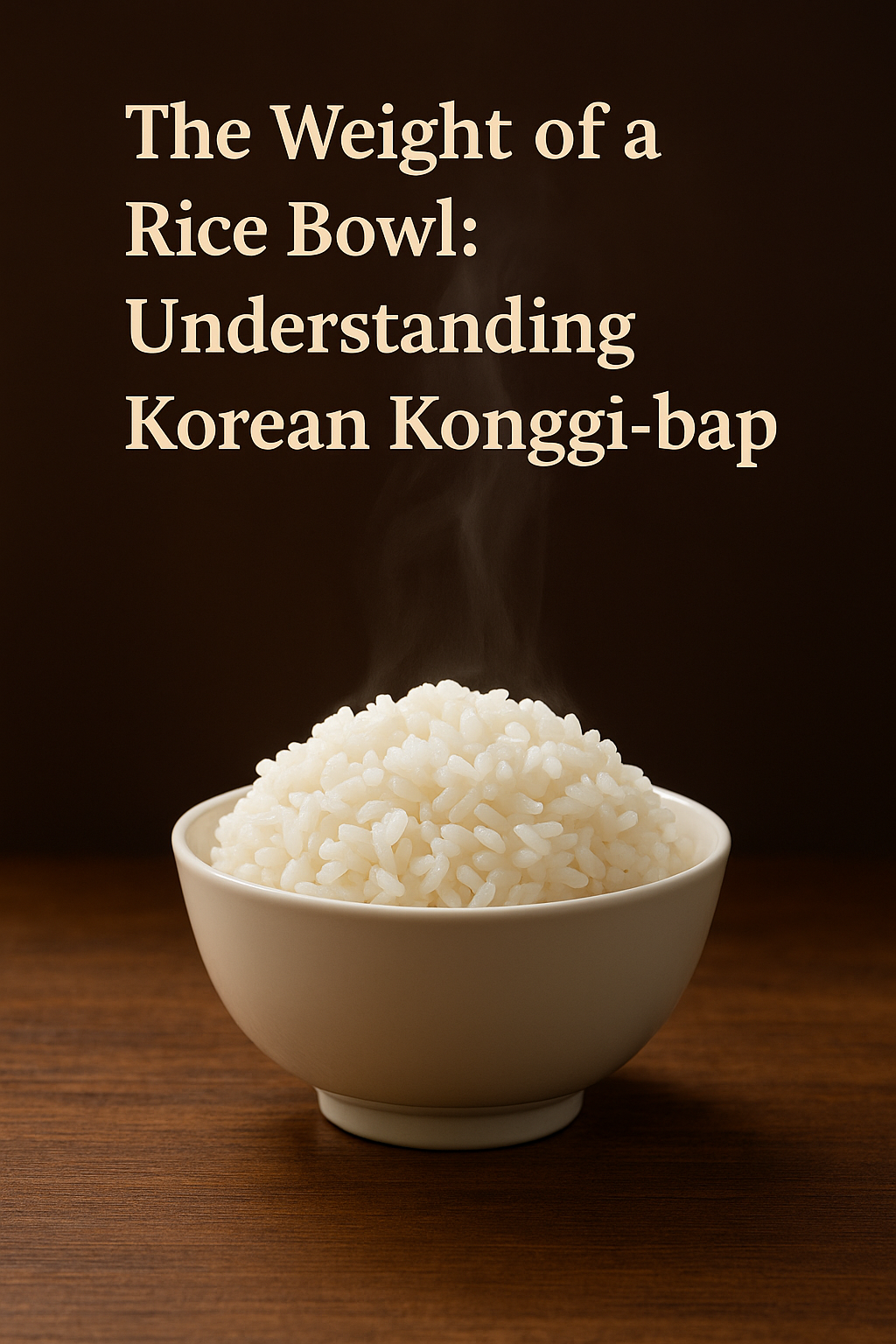
When I came across a recent article titled “A bowl of rice now costs 2,000 won”, I paused for a moment. It’s just a simple bowl of rice, something we order without much thought. Yet the rising price made me realize that even this most ordinary dish carries the weight of history, policy, and culture in Korea.
A Bowl of Rice in Korean Tradition
In the Joseon Dynasty, rice had no fixed portion size. Families cooked rice in large pots and shared it at the table. The word “gonggi” (공기) simply meant the small bowl used for rice, not a standardized amount.
This began to change in the early 20th century, when restaurants became more common during the Japanese colonial period and the years following liberation. Diners now needed individual servings, and rice in a bowl became a unit of value. Though there was no law defining its weight, about 200 grams per bowl became the norm.
Government Policy and the Standardization of Konggi-bap
The real turning point came in the 1960s and 70s, when Korea struggled with food shortages. The government introduced the “Bunsik Promotion Policy” (분식 장려령), encouraging citizens to eat more wheat-based meals and less rice. Restaurants were instructed to limit rice portions, and 160–200 grams per bowl became a de facto standard.
What started as a measure of necessity soon became cultural convention. Today, a bowl of rice is still considered about 200 grams (roughly 300 kcal) in schools, military bases, and restaurants alike.
Why Has the Price Reached 2,000 Won?
The recent jump in rice bowl prices is not arbitrary. Several factors overlap:
- Rising rice prices due to poor harvests, pests, and climate impacts.
- Higher food costs overall, from vegetables to electricity and gas.
- Increased labor costs, as restaurant owners face higher wages.
- Transport and distribution costs, which add to the final price.
Thus, the humble rice bowl has become a symbol of broader economic challenges.
The Concern Over Rising Costs
For Koreans, rice is not just food—it is the foundation of every meal. When the price of a single bowl rises to 2,000 won, it reflects deeper anxieties:
- Daily living expenses grow heavier.
- Real purchasing power shrinks if wages don’t rise in step with prices.
- People worry about future inflation, expecting prices to climb further.
This concern is not only about economics but about culture: if the most basic meal becomes costly, what does it say about everyday life in Korea?
More Than Just Calories
Konggi-bap represents more than 200 grams of steamed rice. It carries the sweat of farmers, the pressures of government policies, the struggles of small restaurant owners, and the daily rhythms of ordinary people.
Each time I lift my spoon over that steaming white bowl, I find myself asking:
“Do I really understand the weight of history and life contained in this one simple serving of rice?”
'일상의 기록' 카테고리의 다른 글
| [리뷰] 탐사 배변패드 울트라, 일상의 작은 안도감 (0) | 2025.09.20 |
|---|---|
| [단상] 두 끼가 당연했던 시절 (0) | 2025.09.19 |
| [단상] 공깃밥, 2천원의 무게 (1) | 2025.09.18 |
| Top 5 Korean Foods You Must Try in Seoul (0) | 2025.09.17 |
| For Koreans, It’s Surprising. For the World, It’s Obvious. (0) | 2025.09.16 |